
|
Makoto translates from Japanese as "sincerity", doing your very
best in every moment, because to do any less is an act of insincerity. The
technology was inspired by the Zen philosophy of the ancient Samurai
warriors, thus its name. Makoto's essence is
"mindfulness": Motion on the outside, stillness within.
Our translation:
|
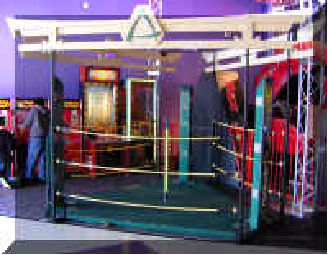 |
Makoto's Design and Play:The total concept and design of the arena follows what is known as "the way of the warrior." In the true warrior tradition, the warrior sees the battle as an inner or spiritual one, in which the fight is within oneself to achieve balance and self-mastery. The key element of Makoto's design is BALANCE. It begins with the equilateral triangular base and the three towers which symbolize balance of the mind, body and spirit. For the Samurai, achieving balance in these three areas were essential for self-mastery allowing them to win and survive their fighting encounters.
The next element of balance is created in the staff. It is from the ancient Japanese martial art Jojutsu. In contrast to a sword which is held by both hands at one end and used to strike with the opposite end, the staff is held with a wide grip and both ends are used for striking. In this way both sides of the body and brain become highly coordinated for maximum performance. The target presentation is totally random so your body moves are non-repetitive giving you a balanced workout. The third element of balance is for the athlete to return to the center of the arena after striking a target. This is a power position. Stances away from center will dramatically reduce the fluidity of movements and performance. From this position striking angles for the body are natural and low impact. Occasionally turning to face a different opponent (tower) as the athlete returns to center adds to the dynamics of the sport. Finally, balance must be achieved between speed and precision of movements. If an athlete moves to slowly, a target will cycle out and move to another one with no point being scored. If an athlete moves too quickly, precision is lost, and they miss one target after another. The secret is to "feel" the balance. | |